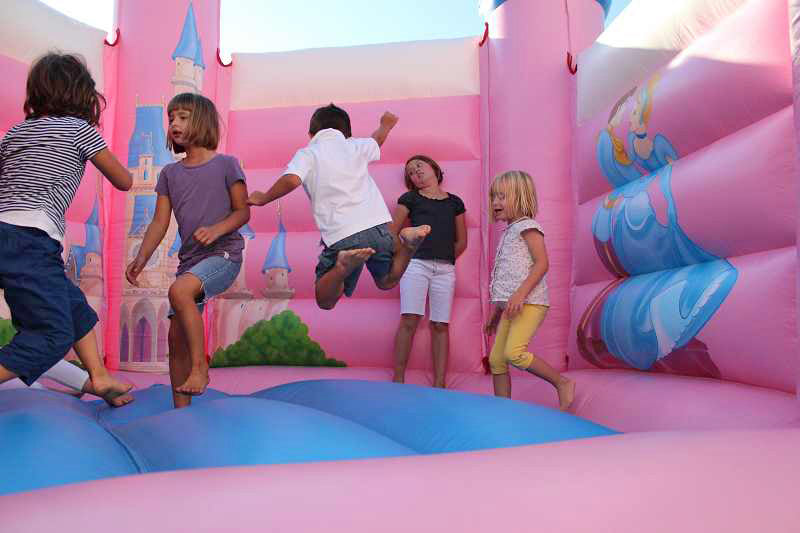
A professional bouncy castle is often the shining centerpiece of any event and a guarantee for enthusiastic guests and a lively atmosphere. It promises hours of fun and unforgettable moments. But in order for this promise to be fulfilled without incidents, more is needed than just plugging in a blower. Proper bouncy castle setup is the foundation for safe play and a smooth-running event.
This guide is your comprehensive roadmap for safely setting up a bouncy castle. Step by step, you will learn what to pay attention to regarding location selection, groundsheet, blower, anchoring, and supervision.
At a glance: Bouncy castle setup in 5 steps
Step 1: Site analysis and professional preparation
Carefully inspect the entire area and remove all sharp or pointed objects such as stones, glass, or branches. Plan a clear safety zone of at least 1.8 meters around the sides and 3.5 meters at the entrance and exit area. Also, check the airspace for obstacles such as power lines, branches, or roof overhangs.
Step 2: Lay out the protective tarp and position the bouncy castle
Completely spread out the sturdy groundsheet on the prepared surface. It protects the PVC material from abrasion, dirt, and small uneven spots. Unroll the bouncy castle on the tarp and position it so that the entrance area is clearly visible to the audience and the blower connection is conveniently located near the power source.
Step 3: Check connections and connect the blower
A particularly important step in setting up a bouncy castle is checking all air release zippers. These must be securely closed before the blower is turned on. Then, securely connect the air inlet hose to the blower nozzle and make sure the hose is straight and free of kinks.
Step 4: Inflating and anchoring according to standards
Connect the blower to an appropriate power circuit and switch it on. Once the bouncy castle is fully inflated and firm, it must be immediately secured at all designated anchoring points. Drive ground pegs into soft soil at a 45-degree angle, or secure the bouncy castle on hard surfaces with heavy ballast weights, for example with suitable water bags.
Step 5: Establish operating rules and ensure supervision
Appoint a responsible, adult supervisor who actively monitors the operation at all times. Communicate clear usage rules to the participants and enforce them consistently. This way, you can always keep an eye on the maximum number of users, the behavior of the children, and potential risks.
The Bouncy Castle Setup in Detail: Expert Knowledge for Safe Events
For all organizers who want to know exactly, we examine here every aspect of preparation and setup in detail. The following guidance is based on important safety principles and the European safety standard DIN EN 14960 for inflatable play equipment.
Chapter 1: Preparation – The Foundation for a Safe Event
1.1 Choosing the Location Smartly: The Perfect Foundation
Choosing the right location is the first critical step. The ground must be flat, load-bearing, and free of hazards. Before laying out the tarp, the entire area should be carefully walked over and cleared of sharp or pointed objects such as stones, glass shards, branches, or nails.
1.2 Safety zones and distances: Space for a safe experience
A bouncy castle should never be set up directly next to obstacles. A free, unobstructed safety zone must be established around it. The European standard DIN EN 14960 provides clear guidelines for this, which should also serve as valuable orientation even at private events: at least 1.8 meters of free space on three sides and at least 3.5 meters in the entry and exit areas.
1.3 Equipment checklist: Everything ready for the bouncy castle setup?
Nothing is more frustrating than realizing in the middle of setup that a crucial part is missing. Therefore, check before starting whether all necessary components are available and ready for use. These include the bouncy castle, blower, protective tarp, ground stakes or ballast weights, power connection, extension cord, and, if applicable, signs with usage rules.
1.4 The Weather Check: Risk Management for Your Event
Weather is a crucial factor that must not be ignored. Wind in particular can be dangerous for inflatable play equipment. The operation of a bouncy castle must be stopped at the latest at wind force 5, that is, about 29 to 38 km/h. Even in heavy rain, thunderstorms, or uncertain weather conditions, the bouncy castle should not be operated.
Chapter 2: Anchoring, Blower, and Power Supply
2.1 Secure Anchoring on Soft Ground
On grass or other soft surfaces, securing is usually done with suitable ground pegs. These should be attached at all designated anchoring points and driven into the ground at the correct angle. Complete anchoring is mandatory to ensure the bouncy castle remains stable during operation.
2.2 Securing on hard surfaces
On asphalt, paving, or concrete, ground pegs cannot be used. In this case, the bouncy castle must be secured with sufficiently heavy ballast weights. It is important that all attachment points are used and that the weights are suitable for the respective bouncy castle.
2.3 Connecting the blower correctly
The blower must run continuously during the entire operation. Place it so that it stands stably, is not obstructed, and does not create a tripping hazard. The air hose must not be twisted or kinked. Only with a consistent airflow does the bouncy castle remain stable and safe to use.
Chapter 3: Safety During Operation
3.1 Supervision is Essential
After the bouncy castle setup, the most important part for safe operation begins: active supervision. An adult should always observe how many children are using the bouncy castle, whether the rules are being followed, and whether weather or surroundings are changing.
3.2 Clear Rules for Use
To ensure that all children can play safely, clear rules should apply. Shoes, sharp objects, food, and drinks do not belong on the bouncy castle. Additionally, children of similar size and age should try to jump together to avoid collisions.
3.3 Regular Checks During the Event
During operation, regularly check the anchors, air pressure, blower, and condition of the bouncy castle. If abnormalities occur, operation should be stopped immediately until the cause is clarified.
An unforgettable event with safety and fun
Setting up a bouncy castle is simple when it is carefully planned and consistently executed. The true key to success lies in three points: choosing the right location, secure anchoring, and constant supervision.
A safe bouncy castle setup ensures that an exciting event becomes an all-around positive memory. Those who conscientiously follow all steps lay the best foundation for carefree playtime and happy guests.
Are you planning a corporate event, a city festival, or another large event and are still looking for the perfect highlight? Let our event experts advise you or discover our innovative solutions for inflatable advertising.