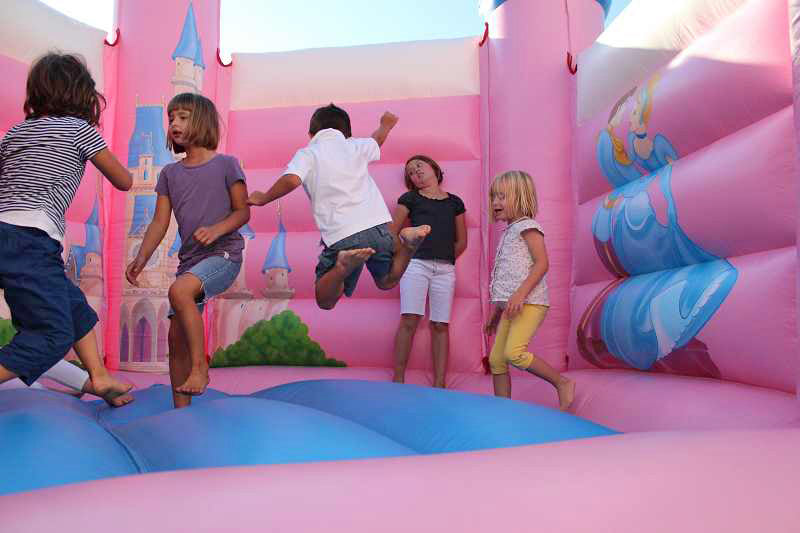
If you want to buy a professional bouncy castle, you often first pay attention to design, size and price. This is understandable - especially with advertising bouncy castles that are intended to make a brand visible and tangible. But the actual quality of a bouncy castle is not only reflected in its appearance. It starts much deeper: with the material, with the technical processing and with the question of whether the bouncy castle was really built for the planned location.
At Happy Fun GmbH For high-quality bouncy castles and individual advertising bouncy castles, we process professional PVC material with 680 g/m as well as reinforced 900 g/m PVC for particularly stressed areas. This choice of material is not a coincidence, but a decisive factor for longevity, safety and lasting advertising effect.
Just at individual advertising bouncy castles and custom-made bouncy castles The material used is particularly important. Because these products should not only look good, but also function reliably at events, promotions, company celebrations, amusement parks or community events.
Free download infographic: High-quality PVC for professional bouncy castles

Why the bouncy castle material is so important
A bouncy castle is a heavily loaded product. Children jump, run, slide, climb and move constantly on the material. At the same time, pressure, tension, friction, UV light, temperature differences and mechanical loads affect the construction.
When used professionally by landlords, municipalities, event agencies, amusement parks or companies, it is not enough to just ensure that the outdoor area is beautiful. What matters is whether the entire product is designed for regular use.
High-quality bouncy castle material must meet several requirements:
It must be tear-resistant so that the construction can safely absorb loads. It must be abrasion-resistant because treads, sliding surfaces and entry areas are subject to particularly high levels of wear and tear. It must remain dimensionally stable so that the bouncy castle remains clean even after many uses. And it must be light and temperature resistant so that the colors, surface and function are retained for as long as possible.
That's exactly why we're here Happy Fun on professional PVC with technical carrier fabric made of PES and on material-appropriate processing in your own company Production and service.
680 g/m PVC: The professional standard for high-quality bouncy castles
With many high-quality bouncy castles from Happy Fun PVC material with 680 g/m is used. This grammage describes the basis weight of the material. Simply put: the higher the value, the more robust the material is usually constructed - provided that the coating, fabric and workmanship are also correct.
The 680 g/m PVC we use consists of PES + PVC. PES stands for polyester fabric, which acts as a supporting structure inside the material. The PVC coating ensures a closed, resilient and cleanable surface.
A particularly important technical value is the carrier fabric PES 1100 dtex in warp and weft. Warp and weft describe the two fabric directions. This fabric structure ensures that the material can absorb loads in both directions.
Technical values of the 680 g/m PVC material:
| property | Value |
|---|---|
| Total weight | 680 g/m |
| Composition | PES + PVC |
| Fabric warp/weft | PES 1100 dtex / PES 1100 dtex |
| surface | shiny at the top / shiny at the bottom |
| Tensile strength warp/weft | 3000 N / 5 cm and 2850 N / 5 cm |
| Tear resistance warp/weft | 300N and 300N |
| Liability | 100N / 5cm |
| Temperature resistance | -40 C to +70 C |
| Lightfastness | 7-8 according to ISO 105 B02 |
| Fire behavior | < 100 mm/min |
These values show: The material is not just “PVC”. It is a technically defined composite material with clearly measurable properties.
Why we also use high-quality 680 g/m PVC on the inside of advertising bouncy castles
When it comes to advertising bouncy castles, the focus is often on the printed outer surface. Logos, colors, characters and brand messages should stand out. But it's not just the visible surface that is crucial for the actual service life.
It is also important which material is used inside the advertising bouncy castle.
At Happy Fun We deliberately use robust 680 g/m PVC on the inside of high-quality advertising bouncy castles. This is a significant difference in quality, because internal partitions, air chambers and structural elements contribute significantly to the stability of the entire bouncy castle.
This is particularly crucial for custom-made products for companies, brands and advertising campaigns. A promotional bouncy castle shouldn't just look good at the first event. It should remain stable even after many uses, stand cleanly and present the brand in a high quality.
Who one Bouncy castle custom-made You should therefore not only ask about the printed image, but also about the quality of the material inside.
900 g/m PVC for particularly heavily used areas
In addition to 680 g/m PVC we use Happy Fun also reinforced PVC material with 900 g/m. This material is used where particularly high loads occur.
Typical areas of application for 900 g/m PVC are:
Slipping areas, heavily used treads, climbing elements, entry areas and special indoor elements such as a wobbly mountain. In these areas in particular, movement, friction and point loads cause significantly higher stresses than on normal side surfaces.
Technical values of the 900 g/m PVC material:
| property | Value |
|---|---|
| Total weight | 900 g/m |
| Composition | PES + PVC |
| Fabric warp/weft | PES 1100 dtex / PES 1100 dtex |
| surface | shiny at the top / shiny at the bottom |
| Tensile strength warp/weft | 4000 N / 5 cm and 4000 N / 5 cm |
| Tear resistance warp/weft | 600N and 500N |
| Liability | 100N / 5cm |
| Temperature resistance | -40 C to +70 C |
| Lightfastness | 7-8 according to ISO 105 B02 |
| Fire behavior | < 100 mm/min |
The difference in tear resistance and tear resistance is particularly noticeable. While the 680 g/m PVC already offers very good values, the 900 g/m PVC has a tear strength of 4000 N / 5 cm in both directions. The tear resistance is also significantly higher at 600 N and 500 N.
This is a real advantage for heavily used areas. This is exactly where it is decided in everyday life whether a bouncy castle remains robust in the long term or shows early wear and tear.

What do tear strength, tear resistance and adhesion mean?
Technical material values seem complicated at first glance. But they are very informative for professional buyers.
Tear resistance describes the tensile force a material can absorb before it tears. This value is important for bouncy castles because the material is constantly under tension. Air pressure, movement and load affect the individual panels and seams.
Tear resistance describes how resistant the material is if there is already a small cut or damage. A high value means: The material offers more resistance to further tearing. This is particularly important in everyday event life because minor damage can never be completely ruled out.
Liability describes how well the PVC coating is bonded to the polyester fabric. Good adhesion is important so that the coating and carrier fabric do not separate from each other.
Light resistance 7-8 according to ISO 105 B02 is also a strong quality value. It shows that the material has a high resistance to light. This is particularly relevant for advertising inflatables because colors, logos and printed surfaces should look high-quality for as long as possible.
Why the place of use is crucial before production
At Happy Fun For promotional bouncy castles and custom-made products, we specifically ask about the planned location. This is an important part of our advice.
A bouncy castle for occasional indoor events has different requirements than a promotional bouncy castle for city festivals, amusement parks, promotions or regular rentals. The surface, the intensity of use, the target group, the duration of the event and the planned support also play an important role.
Important questions include:
Will the bouncy castle be used indoors or outdoors?
Is it rented out regularly or only used for individual promotional campaigns?
Is it on asphalt, meadow, hall floor or other surface?
Should it be heavily used by children or should it primarily serve as an advertising medium?
Are there sliding areas, climbing areas or heavily frequented entrances?
How often is it assembled and dismantled?
This information is used to make the appropriate material and construction decision. This is exactly where there is a big difference between a standard solution and a professionally planned advertising bouncy castle.
Our goal is not to just sell any bouncy castle. Our goal is to develop the best solution for the respective application - technically, optically and economically.
Where cheaper bouncy castles often save money
Price differences for bouncy castles are not just due to size or design. Very often they lie in the material and the workmanship.
Cheaper bouncy castles often save money in places that the customer doesn't see at first glance. These include thinner materials, weaker internal constructions, fewer reinforcements in stress zones or easier processing in heavily stressed areas.
It is particularly critical if the outside looks attractive, but significantly weaker material is used inside. This can be particularly problematic with advertising bouncy castles because these products are often used in a representative manner and must function reliably.
A high-quality advertising bouncy castle is not just an inflatable play device. It is a brand identity. When a company, community or amusement park works with it, the product should radiate trust - visually and technically.
That's why it's worth taking a look at the material data. Values such as 680 g/m, 900 g/m, PES 1100 dtex, tear strength, tear resistance and light resistance are no minor matter. They show how seriously a manufacturer takes the issue of quality.
High-quality material saves costs in the long term
A cheaper bouncy castle can seem economical at first glance. However, it is not just the purchase costs that are important, but also the total costs over the useful life.
If a bouncy castle lasts longer, requires fewer repairs, remains visually high-quality and functions stably even after many uses, it is often a better investment for professional operators.
For landlords, durable material means less downtime and less repair work. For communities it means more security and predictable use. For event agencies it means reliable modules at events. For companies, it means advertising space that not only stands out, but also represents the brand in a high-quality way.
If you think long-term, you shouldn't just ask: "How much does the bouncy castle cost?"
But also: “How is it built, what material is used and what use was it designed for?”
Happy Fun Quality in advertising bouncy castles and inflatable advertising
Happy Fun GmbH has been developing and producing inflatable play equipment, advertising products and custom-made products for professional use for many years. Our experience shows: The best advertising bouncy castle is not created through a beautiful design alone, but through the combination of advice, construction, material selection, printing, processing and service.
For our high-quality advertising bouncy castles, we use robust 680 g/m PVC - also inside the construction. Depending on the use, heavily stressed areas are reinforced with 900 g/m PVC. This creates a product that not only looks good, but is designed to withstand real loads.
Anyone who is a professional Advertising bouncy castle as a custom-made product plans, maintains Happy Fun no off-the-shelf solution. We ask about the location, usage, surface, target group and desired advertising effect. From this we develop a bouncy castle that fits the project technically and visually.
Also for customers who generally have one Buy a professional bouncy castle the material is an important quality factor. Whether it's a standard model or an individual custom-made product: the service life always starts with the right material.
What really counts in a high-quality bouncy castle
You can recognize a good bouncy castle not only by strong colors, clean printing or an impressive shape. You can recognize it in the details that make the difference in daily use.
These include:
high-quality PVC material, resilient PES carrier fabric, strong tear and tear propagation values, reinforced stress zones, well thought-out construction, clean workmanship and advice that takes the actual location of use into account.
It is precisely this claim that characterizes the work of Happy Fun GmbH. We want to build bouncy castles and advertising bouncy castles that inspire, function safely and provide long-term enjoyment.
Because professional inflatable advertising should not only appear large. She is also said to be strongly built.
Free download infographic: High-quality PVC for professional bouncy castles